

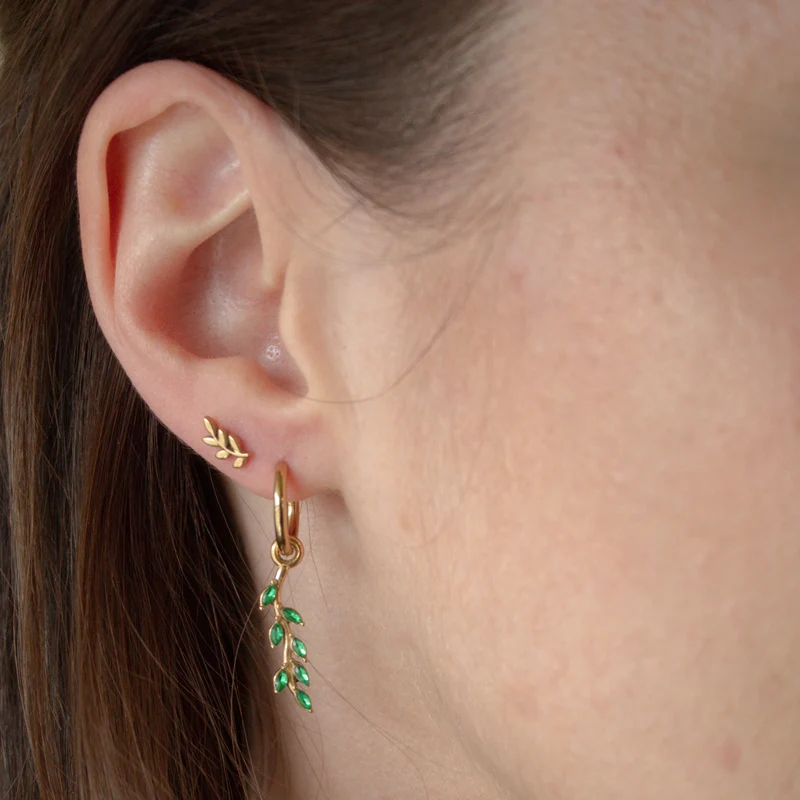
For anyone with reactive skin, shopping for earrings can feel like an exercise in frustration. You find a pair that looks stunning in the store or online, put them in your ears, and within forty-five minutes, the familiar heat begins. Your earlobes swell, turn bright crimson, and throb with an itch that makes wearing the jewelry unbearable. By evening, your piercings are inflamed, and you are forced to retreat to rubbing alcohol, soothing salves, and days of waiting for your skin to calm down.
The jewelry industry does little to help. Racks across department stores and boutiques are covered with cards stamped with the word hypoallergenic. Yet, that label frequently proves meaningless in practice. Because the term lacks formal regulatory enforcement in consumer jewelry manufacturing, brands often slap it on cheap brass or low-grade steel simply because the metal passed a baseline surface test.
Navigating the jewelry counter with truly sensitive ears requires understanding the chemistry of jewelry alloys, recognizing deceptive marketing terms, and knowing which biocompatible metals will never betray your skin.
Why Earlobes React Faster and Harder Than Other Skin
A piece of costume jewelry might sit comfortably against your collarbone or wrist for hours without causing so much as a faint pink mark. Insert that same metal through an earlobe, however, and an aggressive reaction ignites almost immediately.
Ear piercings represent an interruption in your skin’s primary defense system: the stratum corneum. When jewelry enters a piercing tract, the metal is not merely resting on external epidermal skin; it sits against delicate, highly vascularized internal tissue. Earlobes also create a microclimate that accelerates chemical reactions. The junction where an earring post meets the ear collects warmth, sebum, dead skin cells, and sweat.
Perspiration contains salt and moisture, which acts as a mild electrolytic acid. This moisture breaks down unstable alloys, causing microscopic metal ions to leach out of the post and migrate into the surrounding tissue. In individuals with metal sensitivities, the immune system mistakes these migrating ions for foreign invaders. T-cells recognize the metal-protein complexes as pathogens, mounting an aggressive inflammatory response known as allergic contact dermatitis. Once your immune system develops an allergy to a specific metal, that sensitivity lasts for life.
The Common Culprits Behind Contact Dermatitis
To solve the problem, you have to know what you are avoiding. Most people assume they have generally sensitive ears, but their immune systems are almost always reacting to one or two specific, highly reactive elements.
Nickel: The Ubiquitous Offender
Nickel is responsible for the overwhelming majority of metal allergies in the developed world. It is strong, abundant, and remarkably inexpensive. In commercial manufacturing, jewelry makers rely on nickel to add mechanical strength to softer precious metals and to serve as an under-plating that gives pieces a brilliant, mirror-like sheen. Because nickel dissolves relatively easily in the presence of body salts, it leaches rapidly into open piercings, triggering severe redness, swelling, peeling, and oozing.
Cobalt and Chromium
Frequently used as hardeners and whitening agents in fashion jewelry, dental alloys, and costume pieces, cobalt and chromium share molecular similarities with nickel. Individuals who have developed a severe allergy to nickel frequently experience cross-reactivity with cobalt. If a pair of earrings claims to be nickel-free yet still produces an aggressive burning sensation, cobalt in the underlying alloy is often to blame.
Copper, Brass, and Mystery Base Metals
Base metals like raw copper and brass (which is an alloy of copper and zinc) react quickly to skin acidity. While copper is less likely to trigger a true immunological allergic response than nickel, it oxidizes aggressively against the skin, producing greenish-black copper salts (verdigris). This chemical oxidation causes mechanical irritation, clogging the piercing tract and making the ear sensitive, tender, and vulnerable to secondary bacterial infections.
The Safest Metals for Highly Sensitive Piercings
When your ears reject standard fashion jewelry, you must shift your focus away from cosmetic finishes and look toward biocompatible materials used in medical and surgical settings.
Implant-Grade Titanium (ASTM F-136)
If your ears react to almost everything, implant-grade titanium is the premier choice. Titanium is completely biocompatible, meaning the human body does not recognize it as a foreign material. It is the exact metal orthopedic surgeons use for bone plates and dental implants.
When exposed to oxygen, titanium instantly forms a passive, microscopically thin titanium oxide ceramic layer across its surface. This chemical barrier prevents any metal ions from transferring into your tissue, even in humid environments or during heavy workouts. For jewelry, look specifically for ASTM F-136 or Ti-6Al-4V ELI (Extra Low Interstitial) titanium. Commercial-grade titanium (Grade 1 through 4) is generally safe, but implant-grade offers the cleanest metallurgical profile with virtually zero impurities. Titanium is also half the weight of steel, making it ideal for delicate earlobes prone to stretching or tearing.
Pure Elemental Niobium
Niobium is an elemental metal on the periodic table that possesses metallurgical characteristics similar to titanium, but it is softer and more pliable, making it popular among independent artisans for intricate wirework and hoops.
Unlike alloys, pure niobium is not blended with other elements; it is used in its unalloyed, 99.9% pure state. It contains zero nickel, zero lead, and zero copper. Furthermore, niobium can be anodized through an electrical bath to produce a spectrum of vibrant, iridescent colors—ranging from black and bronze to peacock blue and royal purple. Because this coloration comes from manipulating light refraction on the oxidized surface rather than chemical dyes or surface platings, the color will never flake off or irritate your skin.
950 Platinum
For wearers who want luxury fine jewelry that requires zero compromises on skin safety, platinum is unmatched. While white gold relies on mixed alloys to achieve its pale hue, platinum is naturally white and extraordinarily dense.
Fine platinum jewelry is typically stamped PLAT, PT, or 950, denoting that the piece is composed of 95% pure platinum. The remaining 5% is almost always composed of inert metals from the platinum family, such as ruthenium or iridium, neither of which causes skin sensitization. Platinum does not tarnish, does not oxidize against sweat, and never requires rhodium re-plating to maintain its color or protect your skin.
14k and 18k Solid Yellow and Rose Gold
Gold is safe for sensitive ears, but only when selected with precise attention to karatage and alloy composition. Pure 24-karat gold is completely hypoallergenic, but it is too malleable to maintain the structural integrity of an earring post. As a result, gold must be alloyed with other metals to provide durability.
In 14-karat gold (58.3% pure gold) and 18-karat gold (75% pure gold), the remaining percentage is typically composed of silver, copper, and zinc. In traditional yellow and rose gold, these secondary metals are usually safe for sensitive ears, provided the maker does not cut corners by sneaking trace nickel into the melt. Rose gold gains its pink hue from a higher percentage of copper, so if your skin is particularly sensitive to copper oxidation, yellow gold is the safer bet.
Avoid white gold unless it is explicitly certified as nickel-free. Traditional white gold historically relied on nickel as the bleaching agent to turn yellow gold white. If you want white gold that will not inflame your ears, look specifically for palladium white gold, which uses inert, skin-safe palladium instead of nickel to neutralize the yellow tone.
The Problem with Surgical Stainless Steel
Many shoppers turn to surgical stainless steel under the impression that it is medically hypoallergenic. This is one of the most persistent misconceptions in the accessory industry.
Standard surgical steel (most commonly grades 316L and 304) actually contains between 8% and 12% nickel. Under ideal conditions, a passive chromium oxide layer traps the nickel inside the steel matrix, preventing it from leaching onto the skin. However, in an acidic, salty environment like a sweaty earlobe piercing, that passive layer can degrade over time. For someone with a severe or moderate nickel allergy, surgical steel will routinely cause a painful flare-up. Unless your sensitivity is very mild, leave stainless steel alone and choose titanium instead.
Construction Matters: Posts, Platings, and Backings
Knowing the metal composition of an earring is only half the equation; you also need to understand how the earring is built.
The Illusion of Gold Plating
A large portion of fashion jewelry relies on electroplating, where a base metal like brass, zinc alloy, or copper is given a micro-thin coating of gold or silver—often less than 0.5 microns thick.
Within days or weeks of normal wear, friction against the piercing tract wears this paper-thin layer away. The moment the surface rubs thin, your skin comes into direct contact with the reactive base metal beneath, setting off an aggressive allergic response. Gold vermeil (which features a much thicker layer of gold over sterling silver) and gold-filled jewelry (where gold is mechanically bonded to a core metal) offer substantially longer lifespans than cheap plating, but they still pose a risk once microscopic wear occurs.
Prioritize the Post and Wire
The decorative front of an earring rarely causes issues because it sits on the outside of your earlobe. The true danger zone is the post, the ear wire, and the earring back.
When shopping for statement earrings or hanging drops, the entire piece does not need to be solid platinum or titanium. You only need the hardware that passes through your ear to be completely biocompatible. Many sensitive-eared shoppers buy whatever styles they like and simply swap the hooks for raw niobium or titanium ear wires, instantly neutralizing the risk of a reaction.
Pay close attention to earring backs as well. A solid titanium post paired with a cheap, nickel-plated butterfly clutch will still leach metal into the back of your earlobe. Always match your backs to your posts, or switch to medical-grade silicone backings that eliminate metal contact on the back of the ear entirely.
Vetting Your Jewelry Before You Buy
Protecting your ears requires asking specific, direct questions before making a purchase:
-
Look Past the “Hypoallergenic” Card: Disregard generic marketing claims on tags. Look for stamps indicating precise metal composition, such as G23 Titanium, ASTM F-136, 950 Plat, or 14k/18k Solid Gold.
-
Request Nickel-Free Certification: In the United States, jewelry labeling is loosely regulated compared to Europe’s strict European Nickel Directive. Ask the jeweler directly: “Is this piece guaranteed nickel-free throughout the entire alloy, or is it just nickel-free on the plated surface?”
-
Avoid Clear Nail Polish Hacks: A popular internet tip suggests painting earring posts with clear nail polish to create a protective barrier. While this may work for a few hours, the polish quickly chips inside the piercing, leaving jagged microscopic edges that harbor bacteria and introduce toxic chemical solvents into open tissue.
Living with sensitive ears does not mean you are relegated to plain, utilitarian studs or forced to stop wearing earrings altogether. By skipping cheap plated costume pieces and investing in pure, biocompatible materials like implant-grade titanium, niobium, and platinum, you can wear jewelry comfortably all day long without a single trace of redness, itching, or inflammation.

Comments are closed.